Ralph Rucci, The Interview, New York.
DESIGNERS
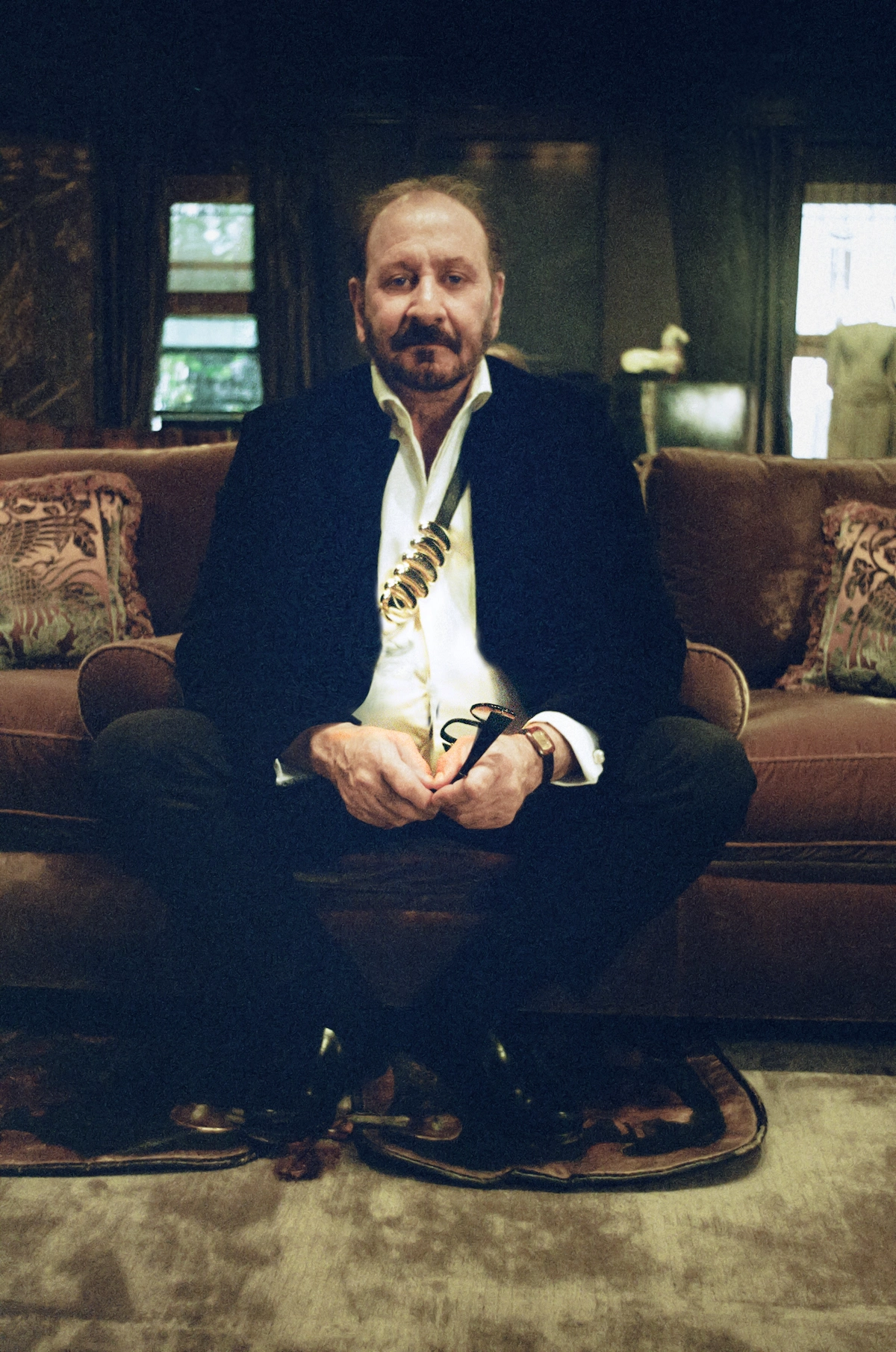
Ralph wearing an original belt by Elsa Peretti
Photography by Patricia Buren, grooming by takashi ashizawa
interview by James V. Thomas
While visiting New York, we had the pleasure of being able to meet and chat with Ralph Rucci.
From issue N°VII, 2024
The name Ralph Rucci might not mean much to most, but in the circles that matter, it’s practically sacred. Rucci is a living legend in the world of couture, having dressed some of the most iconic women in fashion, including socialites like Lee Radziwill and Deeda Blair, aristocrats such as Comtesse Jacqueline de Ribes and Princess Firyal of Jordan, actresses like Elizabeth Taylor, entrepreneurs such as Martha Stewart, and personalities like Elsa Peretti and Diana Vreeland. His creations have graced the most well-heeled clients, defi ning sophistication in an era when veritable couture is scarce. Ralph is a couture designer born in South Philadelphia, based in New York since the 1970s, and having worked under Roy Halston. While traveling this summer in search of new subjects to cover in this issue, I kept thinking of him. A veritable arbiter of taste and style, Ralph persists in his quest to provide women with couture that almost doesn’t exist anymore. He is, and has always been, a lighthouse in a tempest of bad taste, proving that elegance can still exist in a world of designers where one sometimes wonders, “Are we being punked?” Traveling this summer, scouring for stories and wondering if any of them might actually matter, I kept returning to him. The more I thought about him, the more he felt like a secret antidote to everything glossy, hollow, loud, and clownish in fashion today. I took a risk and decided to send him a cold e-mail to see if he would be interested in participating in this issue. I wrote in my most formal, respectful tone, hoping for the best, but expecting to be ghosted. To my surprise, I received an email back from Ralph’s sister, Rosina, who handles communication and press for Ralph. Shortly after, I was put in direct contact with the designer himself.
“EXCITING PROJECT”
was the subject line of the email I received from Ralph, and aft er that, we had a lovely and warm exchange in which Ralph invited me to come meet him in his home on the Upper East Side. It’s a home from another time, unmistakably mid to late twentieth century New York yet so meticulously personal that it transcends nostalgia. Silver and sage hues, deep silks, a dash of animal print in the mix, and—casually placed on a Japanese lacquer side table—a bracelet and cigarette holder once belonging to Diana Vreeland, bestowed upon Ralph by the grand dame herself.
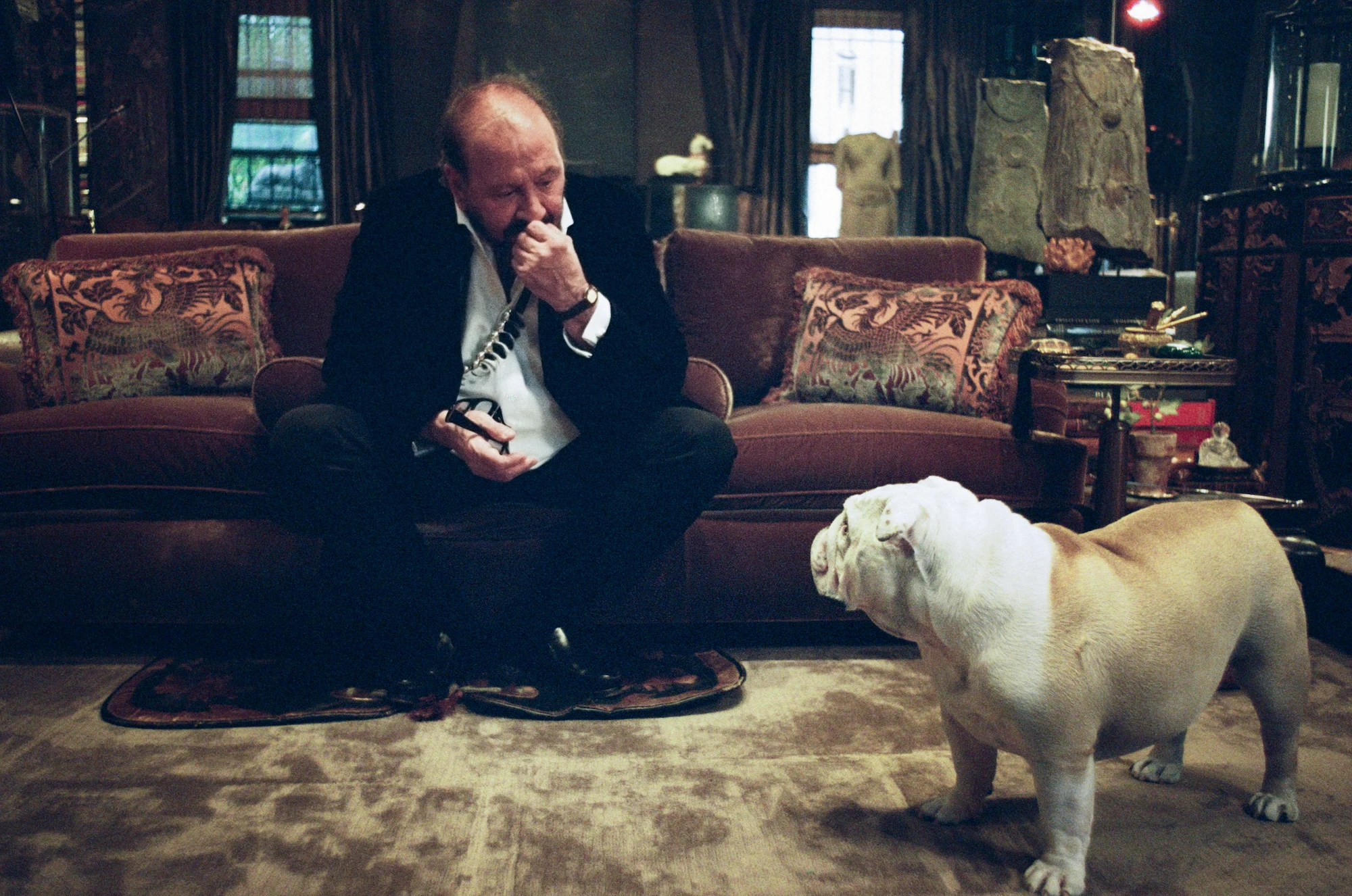
Ralph with his dog, Jimmy.
Rucci’s creativity reaches ready-to-wear, where he applies refined dressmaking methods and rich fabrics. Patricia Mears, deputy director of the Museum at FIT, notes that “Ralph has a deep understanding of fashion history and is a genuine connoisseur of fine art.” As a skilled painter and dedicated art collector, he draws from a varied collection—from ancient Khmer sculptures to modern pieces by Francis Bacon—to shape his designs. One striking example, a black silk organza caftan and pants set, mirrors the grace of Japanese screens, blending art and fashion with ease.
On a hot afternoon in a perfectly arranged penthouse, Ralph and I started to speak. His assistant, Jacek, offered me a drink in a crystal Baccarat flute. Meanwhile, Jimmy, Ralph’s English bulldog, alternated between running and resting around the space, finally settling beside Ralph. Jimmy, he explained, honored James (Jimmy) Galanos, a fellow Philadelphia native and friend—a gifted designer lost too early. As we talked, for a brief time, the outside world, full of noise and change, simply receded.
Introduction
Hello. My name is Ralph Rucci. I’m a fashion designer and, I suppose, an artist by way of fashion. On October 15th, I celebrated my 44th year in business. I’ve always applied myself to the rigor of couture. In 1980, I launched my first ready-to-wear collection, and I always created made-to-order clothes as well. But it wasn’t until 2000 that the Chambre Syndicale de la Haute Couture in Paris invited me to show in Paris, making me the first American in history to do so. Seeing those words was overwhelming—it was the greatest honor of my life, and I realized I had worked and lived for that very moment.
I no longer do ready-to-wear. The complexities of life and the challenges of stores carrying high-end, well-made merchandise make it too costly at the ready-to-wear level. So, I find that focusing solely on made-to-order or couture is more logical and fair. You learn so much from your audience—there’s an intellectual rigor to it. For me, every collection begins with extensive research. Even though I bring decades of knowledge stored in my mind to each sketch, it always feels like starting a new sentence, a new story.
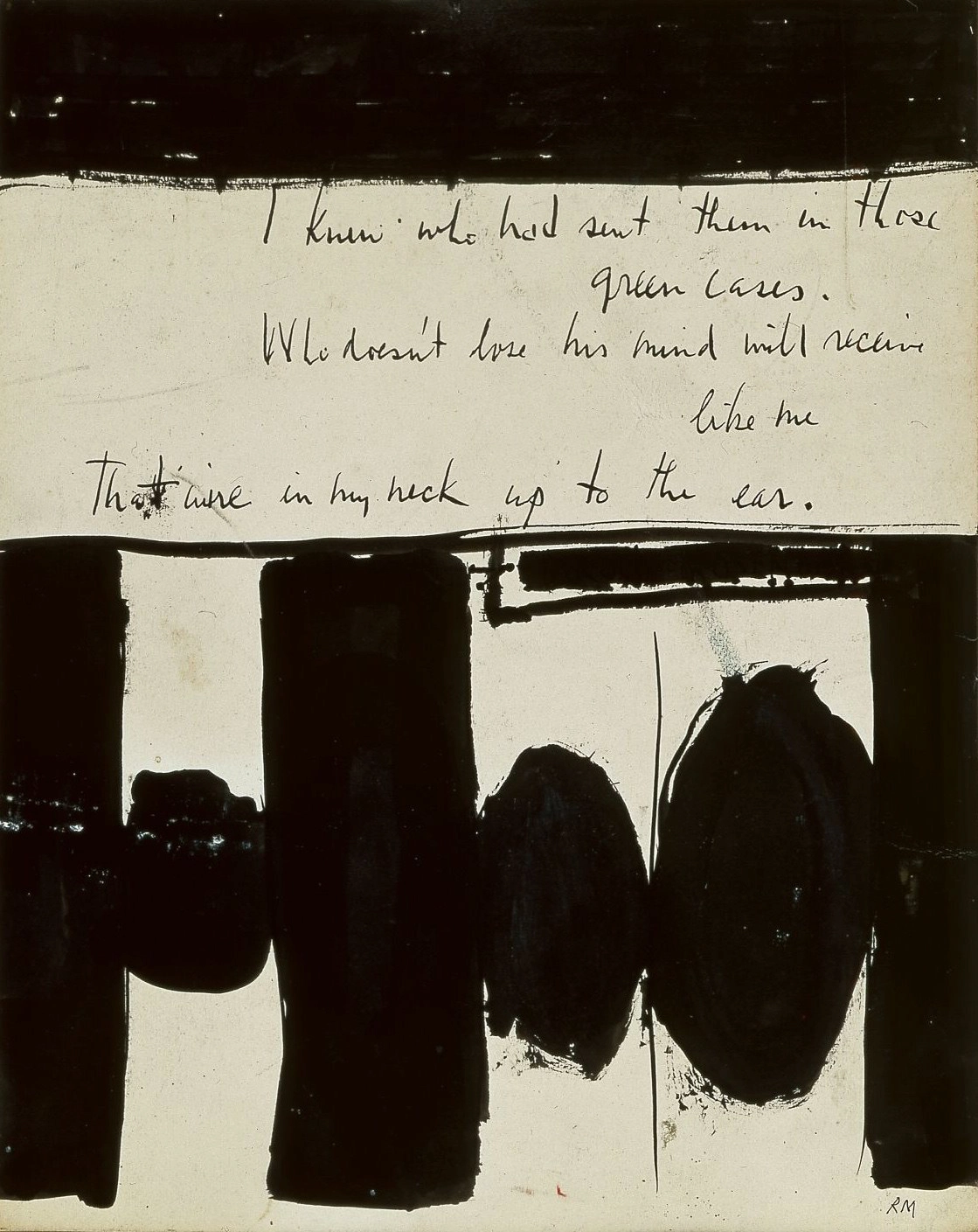
Elegy of the Spanish Republic 1, by Robert Motherwell.
Interview, New York, 2024
Tell us about New York and how you are feeling it at the moment.
Well, I arrived in New York in the ’70s, and it was a different world. I came here wanting to start my career and my life. I was lucky and honored to be hired by the only person I ever wanted to work for—Halston. This may be a big statement, but to me, he was the greatest designer in America. There had been Norman Norell and James Galanos, but Halston was different. Halston was a pupil of Cristóbal Balenciaga, and when I entered fashion, I approached it academically. I studied Balenciaga and Madame Grès intensely, then taught myself. I took fabric, draped it directly on my sister’s body, cut it, and sewed. Through my research, I discovered that the only designer who truly had an affinity with Balenciaga was Halston.
Starting with Halston in the ’70s shaped a lot of my life. Those years were incredibly exciting, and Halston did something profound for society beyond his genius with fashion. Think of what he introduced: Amid all the parties, dinners, and charity events, women, especially Europeans, would arrive in grand ball gowns—Lanvin, Saint Laurent, Givenchy—these big Madame Bovary-like gowns. Halston changed that. He introduced a floor-length cashmere sweater dress, round-neck, long sleeves, in any color, with an Elsa Peretti belt at the waist. I have a sketch from Joe Eula of Mrs. Onassis being fitted in this dress. That’s what he was about. He used bias cutting, taking inspiration from Charles James’s biomorphic shapes and structure.
Then there was the city itself. As Mrs. Vreeland said, it was a ‘youthquake.’ It was a great departure from the past, full of life and optimism. Politically, things felt lighter. We had the best discos—of course, there was Studio 54, but for me, the most extraordinary club, especially for gay men, was The Saint, which opened in September 1980. Men flew in from all over the world. But the ’70s were still all about that great spirit of originality and creativity; there were no boundaries. Sadly, by the late ’70s and early ’80s, men were dying, and that ended so much. But the ’70s were truly electrifying.
Now, how do I feel about New York today? Comparing it to those memories, it’s disappointing. People don’t have the same confidence or the need to dress well, to look their best, to inspire themselves and others. Especially after COVID, there seems to be a lack of individuality; people seem to hide. New York has been overtaken by the obsession with money—super money. Not just enough to entertain people nightly, but super money. And with it has come an imbalance in taste, a lack of simplicity and elegance.
Right now, with everything so politically volatile, I’m also struck by the lack of humility I see, both in adults and the young. Humility is, I think, the most important quality in our lives—it carries us from year to year. It’s about being humble, appreciating our achievements, and recognizing that a higher power has granted us these opportunities.
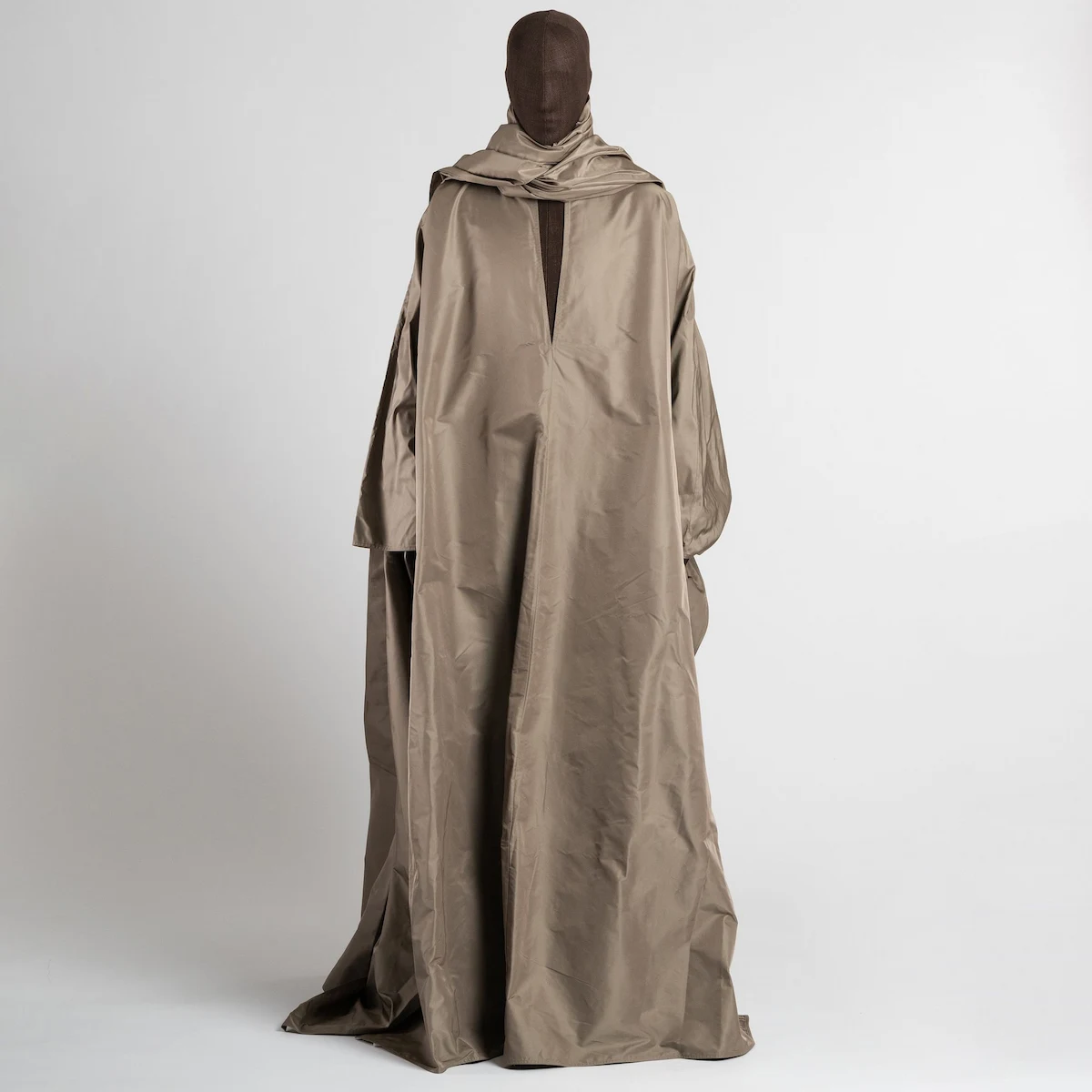

Silk caftan from the collection of André Leon Talley.
From Ralph : This is an Alabaster Paper Silk Taff eta (TARONI) mammoth caftan, or Emperor’s Robe, as we would call them. With it is a matching huge serape of four yards, to swath his neck and trail behind him. He would create utter silence when he would enter a room in these robes, and I indulged him, he had at least 40 in different incarnations. He invented a term, that he would “swan in” - relating to Capote’s Swans - He would arrive at an event and “Swan In”.
Lee Radziwill was not only one of your clients but also a dear friend. Could you share some details about your relationship with her? Did she have any specific styles or preferences when it came to her clothing?
Oh, absolutely. She had a razor-sharp sense of what she wanted—and didn’t want. She loved a strict, straight trouser and a jacket perfectly fitted in the armhole. Anything like a dolman or cocoon sleeve? Forget it. Remember, back in the ’60s, she was experimenting with Courrèges—not just Givenchy—and choosing evening dresses from Saint Laurent. But the designer Lee was truly associated with was the great Mila Schön from Milan. Lee loved Mila’s extraordinary tailoring, especially the double-faced fabrics that showcased impeccable craftsmanship. For her clothing, she favored ivory and always gravitated toward strict, well-made garments. In her homes, however, her favorite color was peony pink, which Lorenzo Mongiardino would use extensively in his interior designs for her. She was always cold, so she had to have really warm furs, and she loved her sables. She was never without a new one—forget broadtail, it just wasn’t warm enough for her. Once, I made her a double-faced cashmere coat with Colombo, who treated the cashmere with galuchat, a type of stingray leather. But when I asked her why she didn’t wear it, she told me, “It’s not warm enough.” So, I added a sable collar, and that seemed to do the trick—she felt warmer with the sable against her neck.
Lee had more chic than you could possibly imagine. But beyond that, she was an intellectual. She couldn’t tolerate boredom and loved being stimulated. She adored the theater and was incredibly well-read. I often think about her during Obama’s campaign—she was a nervous wreck at the idea of him not getting into office. And I can only imagine what she’d think about today’s political scene. She also had a fantastic sense of humor and was devastatingly beautiful—a real gamine, but with an extraordinary allure. Like her sister, she understood the power of eye contact, making you feel as though you were the only person in the room. And she was boldly honest. I remember once, just before a couture show in Paris in 2019, I visited her in New York while she wasn’t feeling well. She looked at me and asked, “Why do you want to do this? Why do you want to ask people to come and see your clothes?” She understood the challenges, and she was direct.
One of the most profound things she ever said to me was after my second couture show in Paris in 2002. We were at the Romanian Embassy, surrounded by crimson marble and ivory veins. The collection was modern yet in soft tones of ivory, beige, ecru, and white. As always, I wasn’t feeling confident at the end of the show, but Lee came up to me and whispered, “It doesn’t matter what you show in the future. What you’ve done here is it—it explains who you are.”
We shared so many incredible times in Paris. Before I even began showing couture, I’d go there for fabric development and work with Monsieur Lesage. One night, it was raining terribly, and I went to pick her up from her place outside the city, that confusing cul-de-sac compound. We went to the Relais Plaza for dinner, where we laughed and talked about everything under the sun. In the middle of it all, a black-and-white French bulldog ran across the dining room. I said, “Lee, it’s Moujik number 5!” Just then, Monsieur Saint Laurent and Fernando Sanchez came in and sat right across from us. I told her, “You have to stop by and say hello—Don’t forget, Mr. Saint Laurent adores you!” She just sighed and said in that inimitable voice of hers, “Oh! Do we have to? It’s so exhausting!” That was Lee.
Can you tell us about the collection you’re working on now?
Oh, I’m sorry, James—I can’t talk about it. When I’m creating a new collection, I’m in this almost psychopathic overload. My mind is flooded with ideas, with no real rhythm from one to the next; it runs the gamut, and I’m never sure how it will all come together. Psychologically, it comes from somewhere deep within, and eventually, it’s just... there. But honestly, it’s a profoundly complex, almost psychiatric endeavor, and I could never fully explain it.
Do you wear cologne, and if so, which one?
Yes, I wear the very first one from Hermès, called Eau d’Hermès. It was made for both men and women, and I adore it because it reminds me of a time in my life when I first came to New York. Another one, also from Hermès, is called Équipage, and I love that too. I tried a Chanel fragrance that she developed for Boy Chapel (Gabrielle Chanel’s English polo player lover), called Russian Leather, but it’s too sweet for me. One old fragrance by Guerlain that I love is Vol de Nuit—that’s weird! You see, sometimes I wear fragrances because people I love, who are no longer with us, wore them. I wear them to keep a part of them with me. There’s a modern fragrance that came out about ten years ago, called Ernesto. It’s very beautiful. The original Vetiver is also a favorite. Elsa also made a fragrance, though it was absurdly marketed by Tiffany. You would receive four small vials in rock crystal, in which the fragrance was placed. I don’t wear it, but when I want to think of her, I’ll smell it. Patou no longer makes Joy, but Elsa wore 1000, so I keep a bottle. Sometimes I just spritz it, walk around, and talk to Elsa—kind of demented, but I have to live in this realm, this space. Also, I could be walking Jimmy (my dog), and suddenly I’ll smell a fragrance, and I know exactly who that person is!
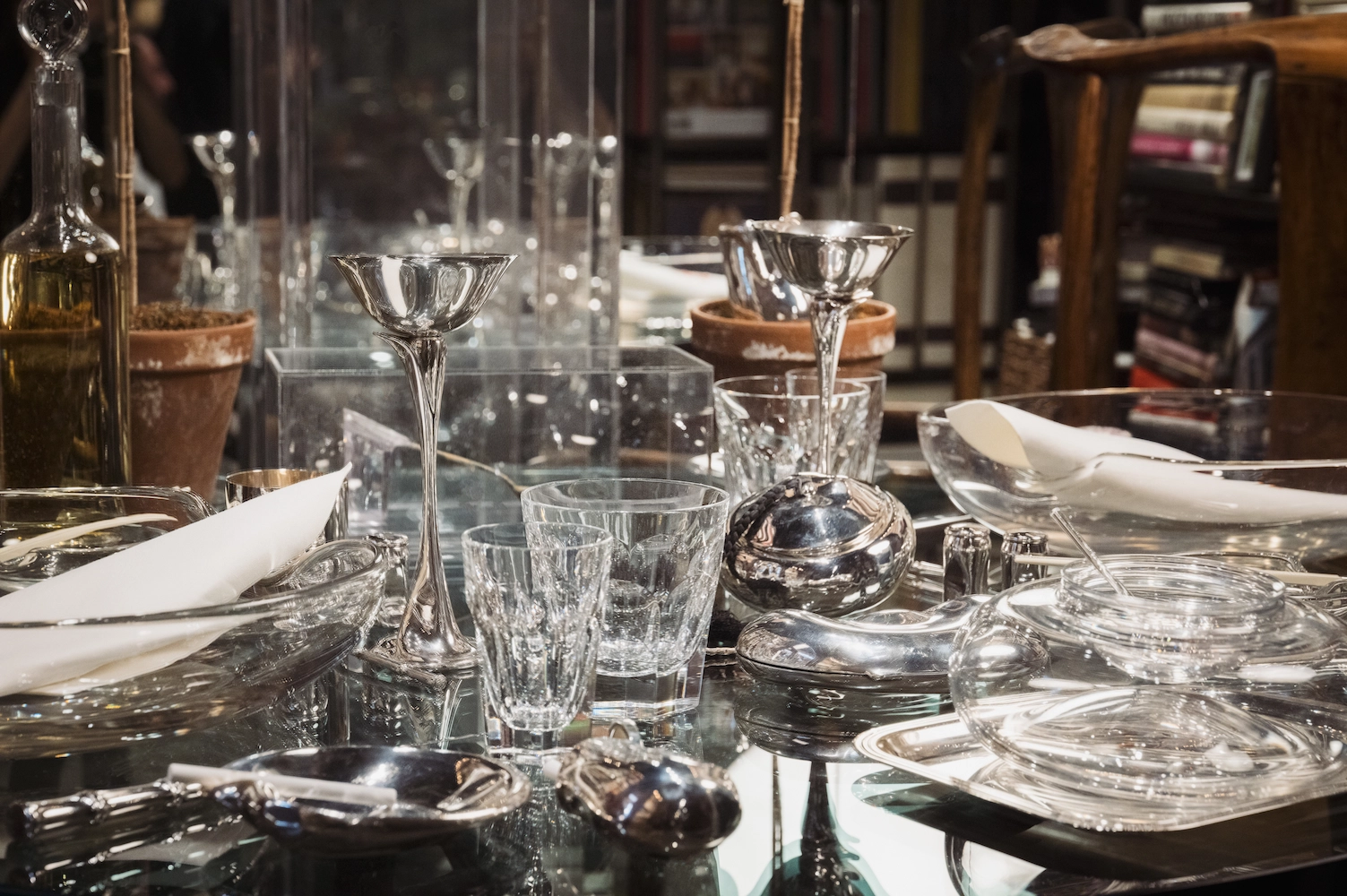
Lunch with Halston & Elsa.
“You see, sometimes I wear fragrances because people I love, who are no longer with us, wore them. I wear them to keep a part of them with me.”
Can you tell us about the table composition you prepared for us today?
Yes, you specifically asked me to create a setting as if we were having lunch with Halston. Halston often hosted formal lunches for business meetings or clients, and while the women were seated, models like Karen Bjornson or Shirley Farro would walk around in outfits the clients were interested in, often leading to a sale. So, I set the table today with all Elsa Peretti pieces, as she and Halston were very close friends, and I’ve been collecting her designs since the beginning. It’s all about a biomorphic relationship in design—no sharp edges—reflecting Elsa’s aesthetic, and also my own approach to cutting clothes. We have Elsa Peretti sterling pieces, flatware by Van Day Truex for Tiffany, a Baccarat wine carafe, and a cigarette box and ashtray by Elsa (since Halston chain-smoked). In the center, there’s a sculpture by Halston’s boyfriend, Victor Hugo, called The Chanel Heel. It’s a soup spoon balanced on a Plexiglas heel, with only four ever made, and I thought it would be nice to include it here for lunch.

Watch with a wooden case, from Boucheron.
From Ralph: This is a watch that Lee gave to me, and I wore it today for this interview to have her with me.
Ralph’s favorite drinks
Chopin vodka on ice, with a healthy splash of Campari - mystically (Roberto) Capucci in color.
Magnificent French Bordeaux wines.
Chateau d’Yquem
Camoille Grappa
Ralph’s restaurants in New York
Il Cantinori
32 East 10th Street
Majorelle
28 East 63rd Street
Le Bernardin
155 West 51st Street
Sistina
24 East 81st Street
Ralph’s places
Assouline Books
979 Third Avenue
Central Park benches around the East 72nd Street Pool
The Gagosian Gallery (when showing Cy Twombly or Francis Bacon)
555 West 24th Street
The Metropolitan Museum of Art, high renaissance wing
1000 5th Avenue