Une Arbitre
HISTORY & PERSONALITIES
written by massimiliano mocchia di coggiola
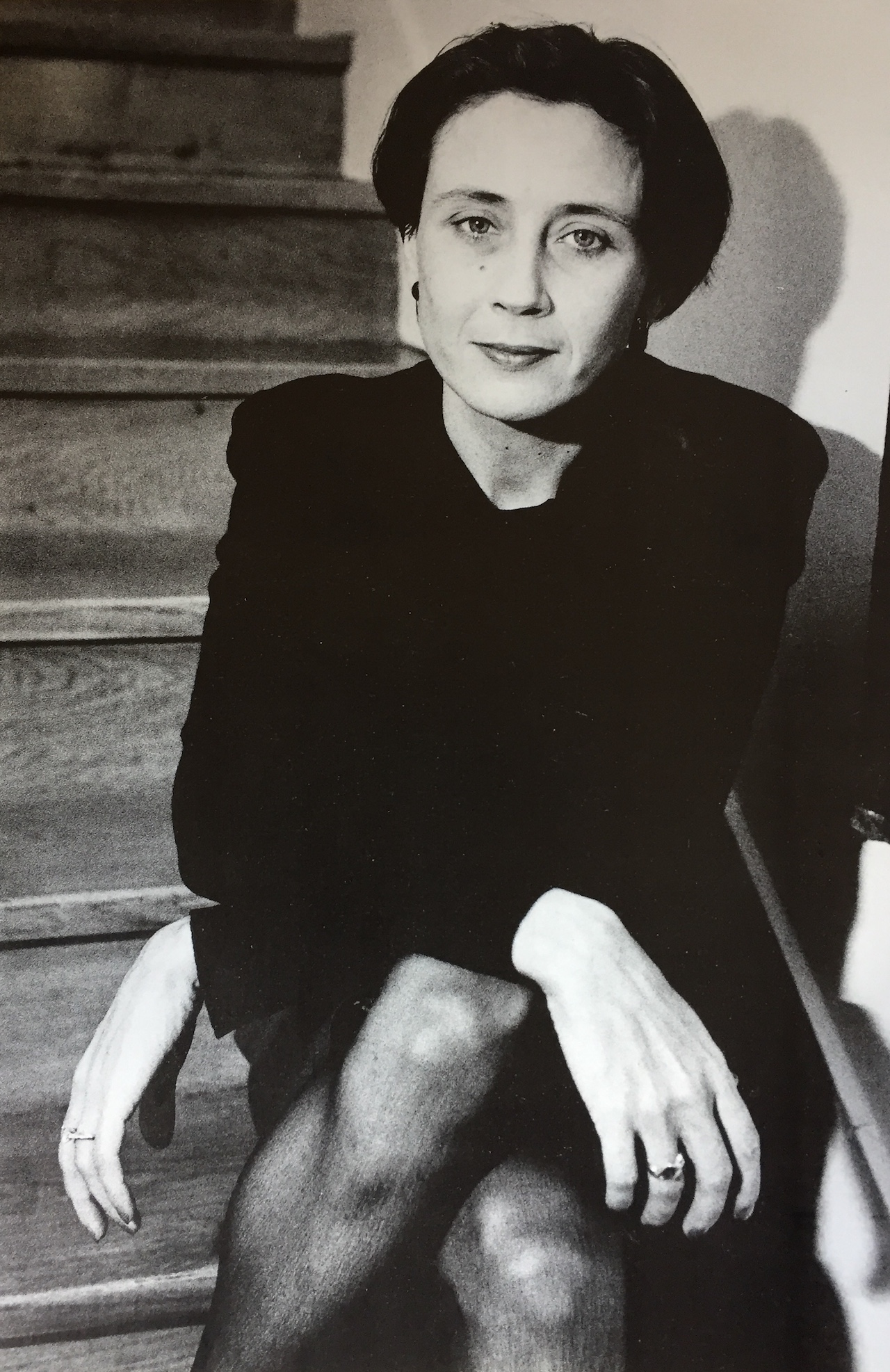
Tatiana Tolstoy, author and personality specialized in men's elegance.
Beautiful, distinguished, noble, tall and slender — in a word, patrician.
In this Orthodox Russian Père-Lachaise that is the cemetery of Sainte-Geneviève-des-Bois—a rather unappealing suburb save for its flower-filled necropolis—rest in peace a large number of figures from the Slavic world who became major personalities in French art and politics. And while Stravinsky and Diaghilev languish in nostalgia in their dreamed-of Venice, here one can visit—for the modest price of a round-trip RER ticket—men such as Prince Yusupov, the assassin of Rasputin. His immaculate tomb never lacks white roses, nor a bottle of vodka; such is the custom. Beside him lies his wife Irina, an elegant androgyne who ran the couture house Irfé. Nearby, Serge Lifar—once the handsome dancer of the Ballets Russes and the impresario’s last lover—rests alongside the sumptuous grave of another ballet star, Rudolf Nureyev.
Silent-film star Ivan Mozzhukhin is buried beneath a simple concrete cross, alas deprived of the monument Charles Vanel would have liked to raise to his glory. The Tolstoy family has but a single tomb—quite large, it must be said—yet surprisingly discreet amid this landscape of white Orthodox crosses. One must pause before the grave that houses Tatiana Tolstoy, born in 1951 and deceased in 1998. She was not merely a descendant of Count Fyodor Tolstoy, a renowned painter in Pushkin’s time; she was perhaps the only female dandy in the history of this eminent, exclusively male “secret society.”
Tatiana Tolstoy, a pink blot in this para-aristocracy of elegance, understood the beauty of menswear—or rather, of style—without ever having felt much attraction toward the opposite sex. Beautiful, distinguished, noble, tall and slender—in a word: well-bred—she possessed an enviable physique and, above all, a pair of eyes that would have made the piercing gaze of the seductive Mozzhukhin pale by comparison. Those liquid-silver eyes swept across the audience seated in the shadows of the Bains-Douches when, in 1987, Thierry Ardisson tried—more or less successfully—to interview her for his show Bains de minuit. Dressed in black, a cigarette in one hand and a glass of wine in the other (those were the good old days of French television!), ironic and perfectly at ease, Tatiana presented her first book, De l’élégance masculine (On Masculine Elegance, Acropole, 1987).
Even today, this book remains a reference in the world of masculine style. It is also a literary UFO, written as it was by a woman in a bibliography composed almost exclusively of men. It is, by far, one of the finest modern works on the subject. Tatiana Tolstoy’s essay was the result of long research that led her to immerse herself in a milieu that, in the 1980s, remained resolutely traditionalist—old-fashioned, even. Though born in Saint-Germain-en-Laye, Tatiana spent part of her childhood in the USSR before returning to Paris to study business at HEC-JF, then working for various publishing houses. Already, in a world of headbands and little gray dresses, the young Tatiana astonished her peers with Sonia Rykiel or Hermès suits.
Tatiana detested conformity, and in the 1970s and 80s she delighted in frequenting both Paris’s underworld and the cream of the nobility. It was in this context that she decided to dedicate a book to the men around her—chic without ever being fashionable.
This is not, in fact, a book about fashion; style would be the proper word to describe this universe which, since the 1930s, has remained unchanged: fashion fades, style never, as another great priestess of taste who made a fortune once said. And if Tatiana’s book sometimes suffers from a certain didacticism imposed by an editor eager to turn it into a manual—something it only partially is—it is in its aphorisms, and above all in its long preface (“The Art of Dressing Well”), as well as in its portraits of elegant men, that her work reveals itself as masterful.
“I dedicate this book to the verb to be, whose abuse—far from trying me—proved necessary to me. One does not appearelegant.” Tolstoy sought to convey an idea of masculine elegance that is timeless and light. To do so, she sketches ten portraits of elegant men identified only by their first names. These anonymous dandies—whose identities I managed, with great difficulty, to uncover—include Pierre d’Arenberg, Hector Bianciotti, Gilbert Cahen d’Anvers, Pierre Cheremetieff… Each is described in his natural habitat—his château, his apartment, or the Ritz—dressed like gods on Earth, charming, refined, languid, portrayed with empathy—and much irony. Tatiana’s voice never falls silent; it is always there, cigarette in hand, half-amused, half-serious, sharp and caustic.
“Why had I been shown only men dressed classically, immediately eliminating those who dress fashionably? Men whose pride often consisted in showing me the date their suit had been tailored.” She believed in this necessary narcissism, this parade of men in tweed and bespoke shoes. She belonged to this world of French aristocrats and White Russians, confined to Paris or Moscow or Rome—for it is more amusing, and more erudite, to describe these societies ironically from within. Discovering the depth of a well-cut jacket or a properly knotted tie, Tatiana plunges headfirst into the “paroxysm of elegance,” allowing herself to be seduced by these men of whom she says that “in matters of seduction, you can trust them,” quickly realizing that “it was not to [her] that they were addressing themselves. Nor even to society. An authentic elegant man will remain so in the presence of a kitchen stool, or even in the middle of the Sahara.”
Some minutes of this program can be seen on YouTube by clicking here.
Her elegant man is a samurai who battles the ghosts of vulgarity and ridicule with wool and silk
In praising rigor, Tatiana was probably the first to link In Praise of Shadows, Japanese philosophy, to the rules of the Western male wardrobe. Her elegant man is a samurai who fights the ghosts of vulgarity and ridicule with wool and silk, and with a tragicomic faith in the laws governing his attire—almost religious laws, founded on nothing but vanity: “One can date the appearance of the tie, certainly, but how does that justify wearing it? What necessity does it obey? And trouser cuffs?”
“Applied with too much rigor, these conventions distance one from elegance. The entire art of the elegant man lies in transcending these vestimentary prohibitions without transgressing them.” A supreme dandy, Tatiana asserts that these precepts apply to manners and obey the following principles: “Not seeming to have learned them; Doing simple things when one could do complicated ones; Being spontaneous even when one does not feel like it; Ignoring effort—or concealing it, which amounts to the same thing; Appearing never to have thought in one’s life; landing a long-haul aircraft whose pilot has fallen ill when one has only ever flown old jalopies, and not boring people with the tale of this exploit…”
Having spoken with several people who knew her, who were her friends in their youth, I received confirmation of what I had already suspected upon first reading her book: that Tatiana Tolstoy was profoundly nostalgic for “a world that no longer exists” (as Prince S. d’A., her friend before his marriage, once told me). She was nostalgic for a bygone world of nocturnal costume balls at the Hôtel Lambert, journeys to ancient Venetian palaces, exiled fake grand dukes and handsome Russian dancers, renowned tailors and very noble spendthrifts. This constant quest for beauty went hand in hand with an eternal disappointment: that of discovering, at every moment of one’s life, that the world is not as one imagined it, that people—even the most highly placed—do not share these aesthetic ideals.
Her dandysme was, in sum, part of a “perilous tradition that forces one to saw off the branch on which one is sitting, a tradition of negation that can even lead to the ironic cult of vestimentary convention.” It is doomed to failure, needless to say. But after all, what could be nobler than losing beautifully? The arrogance of winners has always had something terribly vulgar about it.
Reading Tatiana Tolstoy’s book makes one want to read more from her pen—but this would be a vain quest. Aside from a handful of romance novels that could be described as youthful works, written under various pen names, and a children’s book about Russia under Catherine II, Tatiana Tolstoy was swept up in the vortex of life; death met her when she was only forty-seven. When the sad news spread, little was known of her final years, which were sometimes difficult. She died of a sudden illness, leaving behind this single work worthy of her ideals of distinction.
Those who had the good fortune to know her will always remember her gaiety, her biting humor, and her taste for farce—a way of never taking herself too seriously, nor the world around her. What, indeed, can be said of a writer who chose to disguise herself as a nun to meet an English lord in his country attire, to his great dismay? Baudelaire’s famous motto—épater les bourgeois—would so perfectly suit this dandy, the most baroque of all the characters who appear in her book.
“Like those Bengal fires that dazzle the twilight of a party, or bursts of laughter overheard while walking beside a hawthorn hedge, the appearance of an elegant man is too fleeting, and his disappearance too frustrating, not to haunt one’s memory for a lifetime.” One would like to say the same of Tatiana Tolstoy.
Massimiliano is a writer and aesthethe based in Paris. In 2017 he published a book called Dandyismes and is a regular contributor to numerous magazines internationally. He also designs with his brother for their clothing and accessory brand Fratelli Mocchia di Coggiola.
SKY BLUE
Est. 2019